home | galleries > pre-columbian > colonial > shipibo > african > asian > classical > pacific rim | restoration services | display stands | about | contact
African
Welcome to the African Art Gallery. Offered here are antique Tribal artworks as well as ancient African terracotta items.
This gallery will be regularly updated so check back often. Please ask if you
would like additional photos or more in-depth descriptions. Enjoy your treasure hunt...
NOTE:
All items being offered on this website have appropriate provenance and are legal to buy and own under the United States statute covering cultural patrimony Code 2600, Chapter 14.
Every purchase comes with a written certificate of authenticity (COA) and are fully guaranteed to be as described. Provenance and accurate, detailed condition information is included with each listing.
To Purchase or Ask a Question:
Contact me via email at: joey@ancientartifax.com or call 828-322-2942. Payment options are check, money-order or PayPal. Credit Cards can be processed through PayPal. Discount may apply on the purchase of multiple items.
Shipping costs are not included in the purchase price. Shipping options are (U.S. only) via USPS Priority Mail, UPS Ground or FedEx. Tracking info will be provided.
Fragile items will be double-boxed.
International Sales: Shipping outside of the United States is no longer available. International shipping has become overly stressful and is no longer an
option due to unpredictable costs, customs issues and import/export restrictions that vary by country.
 |
 |
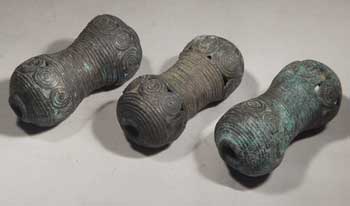
Large Baule Bronze Beads — Ivory Coast
Early to Mid 20th Century
Three large bronze (copper/brass alloy) beads from the Baule people of the Ivory Coast. The beads are rounded on the ends and narrow at the center.
Each bead is similar, having spiraling geometric designs. They could be strung together as a necklace or bracelet or used separately as pendants.
In fair condition with heavy patination. Each has small losses (casting flaws), but are wearable as jewelry. Each is approx. 3" long x 1.5" across.
$125 for all three
|
 |
|
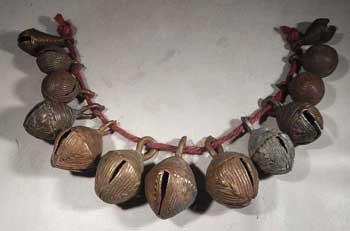
Baule Bronze Bells — Ivory Coast
20th Century
A group of 13 vintage bronze bells from the Baule people, Ivory Coast, Africa. Cast in bronze (copper/brass alloy) using the lost wax method. The bells
are graduated in diameter (large and medium) sizes and all have similar designs. The strand of bells measures approx. 11 inches long.
They could be worn together as a necklace or divided and used as pendants, bracelets or other jewelry items. In good condition with nice patination. Some have small losses and casting flaws, but are heavily cast and wearable.
Bells vary from approx. 0.75" to 1.25" in diameter.
$150
|
 |
|
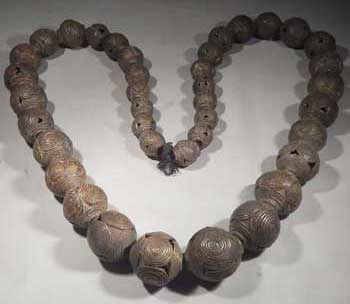
Baule Bronze Beads — Ivory Coast
20th Century
A long strand of 39 vintage bronze beads from the Baule people of the Ivory Coast. Cast in bronze (copper/brass alloy) using the lost wax method. The beads
are graduated in diameter from large to medium sizes. Each bead is similar in design with spiraling concentric circles. The 'necklace'
measures approx. 40 inches long and could easily be divided into 2 necklaces or the beads used separately as pendants for numerous pieces of jewelry. In good condition with nice patination. Some beads have small losses and casting flaws, but are heavily cast and wearable.
Beads vary from approx. 0.75" to 1.25" in diameter.
$250
|
 |
|
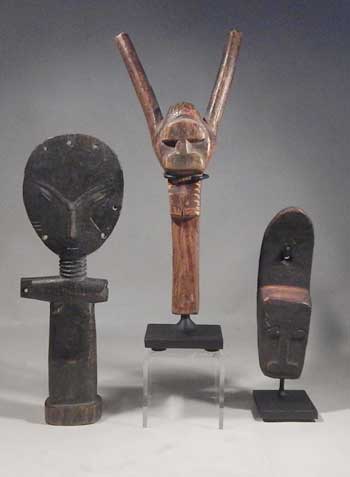
African Doll, Slingshot & Pendant — Ivory Coast & Ghana
All Mid-20th Century. Ex. J. Behnkin estate of Atlanta, GA.
#1 (left) A very nice and older Ashante Aku-Aba doll. Finely carved in the traditional manner with rounded flat head and arms extended.
In good condition. One hand is missing. The edges are worn and overall the surface is smooth from extensive tribal use and handling.
Approx. 7.25" tall. $200
#2 (center) A fine Baule slingshot (potomo waka). Well carved depicting a stylized figure with abstract face. At the 'neck' are carved notches,
probably 'tally marks' to record kills. Baule fathers often commissioned slingshots for their sons to hunt small game such as birds and rabbits. It was a rite of passage for a young Baule boy to master his slingshot before becoming a warrior. Far from being toys, these weapons were considered objects of value and spiritual significance.
In choice condition. Display stand included.
Approx. 7.75" tall. SOLD
#3 (Right) A rare Baule pendant with abstract face and encrusted surface. Pendants of this type were attached to a cord and only worn by
a Hogon (priest) of the tribe or sometimes strung over important shrine figures honoring ancestors. In excellent (aged) condition.
Approx. 4.5" tall. 5.75" tall on the stand. $150
#2 has been sold. #1 and #3 are priced individually or $300 for both.
|
 |
|
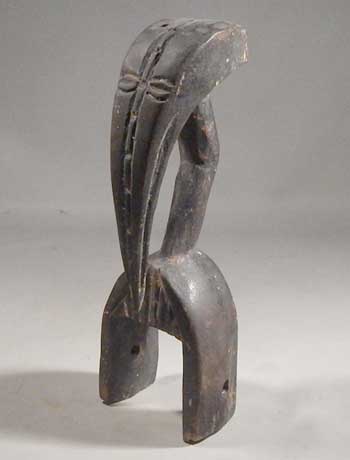
Senufo Heddle Pulley — West Africa
Mid-20th Century
An exceptional Senufo heddle pulley from Western Africa. The pulley depicts an image of a stylized Hornbill crane, a favorite theme among West African peoples since it is one of the sacred creatures associated with giving birth to members of the Poro society. Made from a medium weight, tight grained wood. Pulleys like this had to be carved from hard, dense wood as they were exposed to a tremendous amount of stress in the weaver's mechanism.
In near excellent condition with a rich, darkened patina. The edges are smoothed from age, wear and extensive tribal use. A fine and beautifully carved example.
The Senufo (Senoufo) people, also known as Siena, Senefo and Bamana, are a West African ethnolinguistic group. They consist of diverse subgroups living in a region spanning the northern Ivory Coast, southeastern Mali and western Burkina Faso. Their art is typically well executed, finely crafted and aesthetically appealing.
Ex. J. Behnkin estate of Atlanta, GA.
Approx. 6" tall x 2.25" across.
SOLD
|
 |
|
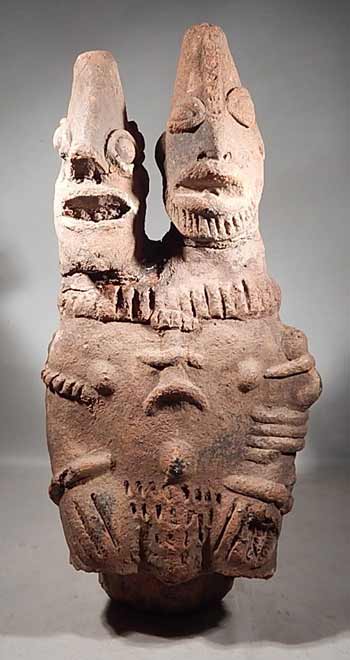
Koma Pottery Figure — Ghana, Africa
1100 AD - 1500 AD
A large and very rare Koma pottery figure from Ghana, dating to the 12th to 16th Century. This complex 'duality' sculpture is comprised of
two conjoined bodies topped by two janus-form heads. There are two pairs of faces, two are bearded males and two are females; facing in opposing directions. The heads are elaborately detailed with bold features characteristic of the Koma; including elongated heads, large coffee-bean shaped eyes and pronounced chin.
The bodies are further adorned with applied necklace/collar with figural pendants, loin cloths, armlets and bracelets.
Also seen are the extremely long fingers, pronounced breasts, and protruding navels; all common traits of Koma figures from this period.
In good condition. Both heads have been reattached with visible glue lines. Three legs are missing as are the toes of the fourth leg. Numerous small losses and
surface erosion along with several stable cracks. Overall shows a weathered surface with deposits as would be expected. Scattered roots imbedded, mostly in the deep crevices. An exceptional artifact from a little-understood people. Figures like this are typically found fragmentary.
Seldom seen this intact and original. A fine example.
Koma figures were originally discovered in the 1980s in what is known as 'Koma Land'. The first were found during archaeological fieldwork directed by Professor Ben Kankpeyeng of the University of Ghana. Although there is little known about how such sculptures were used, scholars have suggested they were used in special ceremonies and rituals in which the spirits of the ancestors were invoked.
Ex. Eugene M. Kalinowsky estate of Pittsburgh, PA. Mr. Kalinowsky was an artist, teacher, world traveler and collector.
Approx. 15" tall x 7" across.
$1750
|
 |
|
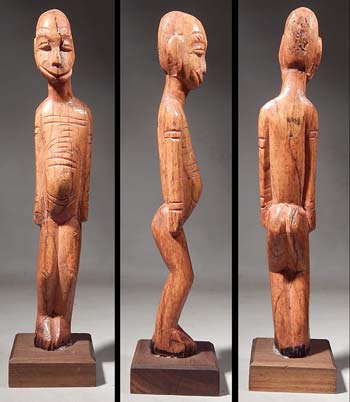
Lega Bone Inginga Figure — DRC
Late 19th - Early 20th Century
A fine, old Lega 'Inginga' figure from the Democratic Republic of the Congo. Carved from bone, sometimes in Ivory, these figures (called Iginga)
are individually owned by only the highest ranking members of Lega society. Each member of 'Musagi wa Kindi' owned a bone or ivory human inginga figure as a sign of his status.
They are the most coveted of all initiation objects. This early Colonial Period example is in excellent condition. A few vertical age cracks that occur naturally
over time. The surface has a lovely honey-colored patina. An extremely rare and older tribal example. Comes mounted to a wooden block.
Ex. Eugene M. Kalinowsky estate of Pittsburgh, PA. Mr. Kalinowsky was an artist, art teacher, world traveler and collector. He passed away in 2014 at the age of 85.
Approx. 8.25" tall. Just over 9" tall mounted.
$975
|
 |
|
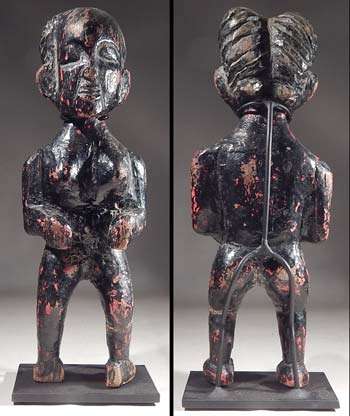
Baule - Akan Colonial Painted Figure — Ivory Coast
Late 19th - Early 20th Century
An old and exceptional Baule - Akan standing female figure from Africa's Cote d'Ivoire (Ivory Coast), dating to the early Colonial Period.
This fine example was once painted in red and green, then repainted in early 20th Century with a black oil-based paint,
a common practice during early Colonial times in this region. In near excellent condition. Minor losses to both feet otherwise intact, complete and original.
Small areas of paint chipping and wear from age and extended tribal use; as would be expected. Displayed on custom metal stand, included as shown.
Ex. Eugene M. Kalinowsky estate of Pittsburgh, PA.
Approx. 10.25" tall x 3" across
$850
|
 |
|
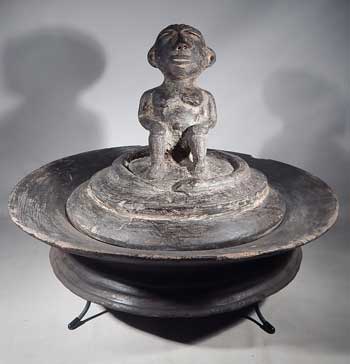
Akan Ancestral Funerary Vessel — Ghana, Africa
Mid-20th Century
A large funerary vessel from the Akan tribes of Ghana. These blackware pottery vessels with figural lids are known as 'abusua kuruwa' or family pots.
Atop the lid is a seated figure that represents an (idealistic) portrait of the deceased. Below the figure is a snake, meant to be a python, a symbol of death that encircles
every living person.
The abusua kuruwa were used in secondary burial rituals by the Akan. Family members would place hair and fingernail trimmings into the vessel as mementos of themselves
for the deceased. Since hair and nails grow throughout our lives, these personal offerings empower the deceased to continue to 'grow and live' in the afterlife.
The vessel, along with food and palm wine are presented as offerings to the deceased.
The bowl section has a rounded botton, ribbed sides and a wide rim. The lid is a dome-shaped platform supporting the serpent and figure.
Overall in good condition. Restoration to the rim of the lid and head of the figure. The bowl has some restoration to the rim. Both pieces have edge chipping, scrapes and
surface wear consistent with age. Custom display stand included. Ex. M. Dailey collection of Charlotte, NC.
Approx. 15" across x 12" tall. Approx. 13" tall on the stand.
$950
|
 |
|
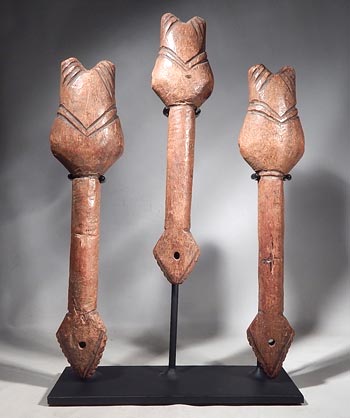
Mossi Flutes — Burkina Faso
Mid-20th Century
A trio Mossi carved wood flutes (whistles) from Burkina Faso. An extremely rare set of three matching flutes, all with identical shapes and designs.
Each has a wide mouth-piece with carved linear decoration and holes on each side to create different notes. The opposite end is pointed and has a suspension hole so they can be worn around the neck.
The three were most certainly from the same tribal group and all made by the same carver. These flutes from the Mossi (also Lobi and Bwa peoples) are played to accompany balafons and
drums during ceremonies and mask perfomances. They can be played singly or in groups. A flute plays a set of notes with a complex but very repetitive tune.
Some flutes were also used by groups of hunters for communication. These are likley hunters' flutes as indicated by the pointed tip which is
shaped like an arrow head. Also the the suspension hole makes them wearable and more easily 'portable' during hunting expiditions.
Each is in fine condition with aged patina and signs of heavy tribal use. An exceptional set that displays nicely on the custom metal stand with is included as shown.
Ex. Southern California estate collection.
Flutes range from 9.25" tall to 10.5" tall. Overall display is 13" tall.
$750 for the group.
|
 |
|
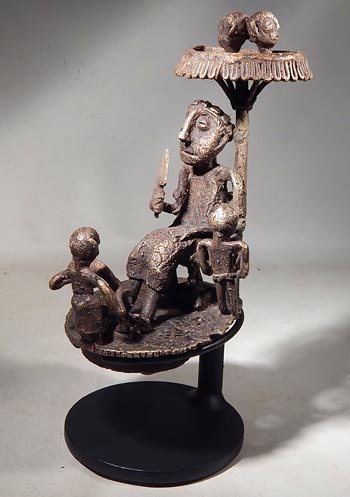
Ashanti Bronze Figural Lid — Ghana
20th Century
An Ashanti sand-cast bronze (brass alloy) figural scene from Southern Ghana. This is a lid that would have originally covered a bronze vessel or bowl, now missing.
This type of vessel, with a figural lid, are said to have held golddust, but also are sometimes referred to as medicine
pots. It depicts a chief or tribal leader sitting on his throne surrounded by two attendants.
The chief holds a knife (dagger) as a sign of status and power. He wears a tunic decorated with interlocking circular designs.
One attendant holds an umbrella topped by two human heads. The heads likely representing killed or captured enemies. A second attendant stands at the chief's feet, presenting a sword
as an offering. The base (platform) is decorated with complex circular and linear geometric patterns. In fair to good condition. The umbrella and chief's dagger have been reattached and there are losses to the base and lower rim of the lid.
These losses are possibly casting flaws. A custom metal display stand is included as shown.
Ex. M. Dailey collection of Charlotte, NC.
Approx. 5.5" tall x 3.5" across. Approx. 8" tall on the stand.
$225
|
 |
|
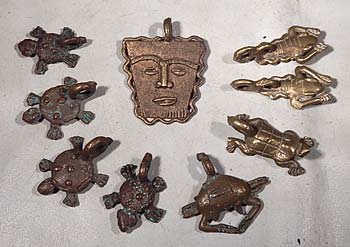
Ashanti - Akan Bronze Pendants — Ghana
20th Century
A collection of 9 (nine) Ashanti - Akan brass-bronze alloy pendants cast in the lost-wax technique.
The pendants (which may have also served as gold weights) contain a mask, turtles, scorpions and crab motifs.
Great for jewelry as necklaces or on charm bracelets. In good condition. All are intact. Some show tarnishing and light oxidation from age,
but are sturdy and wearable.
Sizes vary from approx. 1" to 1.75".
$150 for the group.
|
 |
|
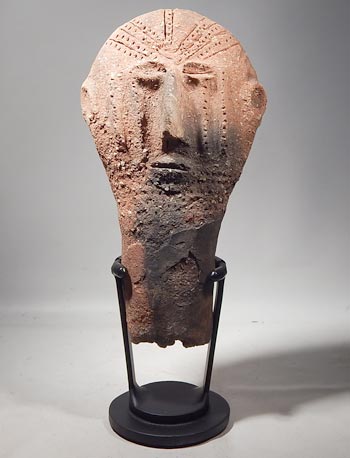
Bura Terracotta Head — Niger
3rd to 11th Century AD
A nice pottery head from the ancient Bura culture of Niger, Africa. Solid terracotta construction with elongated neck and stylized facial features as is typical.
Eyes, nose and mouth are sculpted in high relief along with linear incising and stippling, representing ritual scarification. Broken at the bottom of the neck which would have orininally had a flared base.
In good condition although the front has been scorched and shows dark (burned) areas on the surface. Much of the smooth outer surface has been lost to reveal the gritty tempered clay underneath.
Fire damage is not common on Bura artifacts, but is understandable as these are typically found in fields during planting in areas that practice "slash and burn" agriculture.
Displays well on the custom metal display which is included.
Little is known of the Bura civilization. Their art was first discovered in 1975. Most of the objects being excavated are terracotta heads or vessels.
Many of these terracotta heads are fragments that are often damaged by plowshares and other tools during planting.
Just over 8" tall x 4" across. Over 10" tall on the stand
$450
|
 |
|
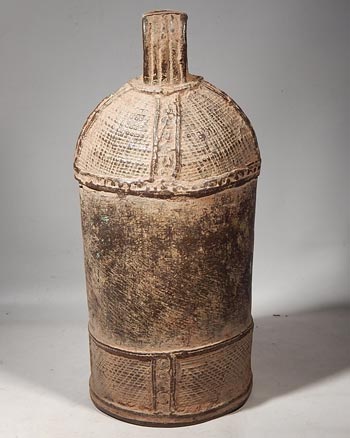
Igbo Bronze Bell — Nigeria
Early to Mid 20th Century, possibly older
A large antique bronze bell from central Nigeria. Made in the lost-wax casting method by Igbo (or Igala) metalsmiths.
Decorated at the top and bottom with sections of crosshatching divided by bands of circular designs. Condition is very good.
There is a thin crack just below the domed top and a one-inch diameter hole on one side, otherwise intact. The iron clapper rod is suspended inside with modern string.
A fine and old example with earthen encrustations and a few small areas of green oxidation.
African ritual bells were used for a variety of purposes, such as proclaiming a sacred presence as well as neutralizing hostile or harmful forces.
Bells were used as tools of communication, as portable instruments for conveying important messages, and as a form of currency.
Just under 9" tall x 4" across
$275
|
 |
|
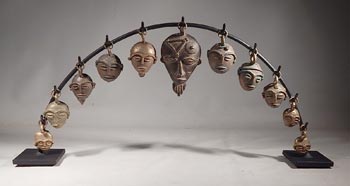
Baule Pendant Masks Collection — Cote d'Ivoire - Ivory Coast
20th Century
A fine collection of eleven brass-bronze pendant masks from the Baule people of the Ivory Coast.
Pendant masks are not normally worn by most Akan peoples. They are most often found attached to various chiefly regalia, prominent sword sheaths or chiefly stools.
They are said to represent the heads of defeated enemies and typically show stylized beards, facial scarification and forehead ornamentation. All are in nice condition and display well on the custom metal stand, included.
Masks approx. 3.25" tall to 1.25" tall. Display is 16" long x 7" tall.
$325
|
 |
|
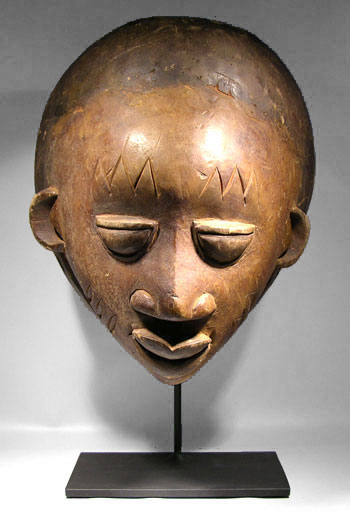
Yoruba Gelede Mask — Nigeria
Early to Mid-20th Century
A lovely Yoruba Gelede mask from Nigeria. A visually striking example, well carved and of high quality showing exquisite craftsmanship.
As is typical of Gelede masks of this period, the forehead is prominent along with stong, almost exaggerated features. There is facial scarification on the forehead and cheeks.
The face is a brownish ochre color with a darker color (once black) for the hair.
Gelede masks, such as this one, were worn by male Yoruba dancers at festivals honoring the women of the community, both living and dead.
The masks were "danced" in elaborate performances known as "Gelede." This ritual would take place each year at the beginning of a new agricultural season. The purpose of the performance is to pay tribute to the special power of women, both
elders and ancestors, who are known affectionately as "our mothers." Through their movements, gelede dancers express Yoruba ideals of male and female behavior.
Condition is near choice. Some pigment fading, general light surface wear, worm-holes and minor insect damage consistent with age. An exceptional example with obvious signs of age and tribal use. Custom metal display stand is included as shown.
Excellent provenance. Originally collected in the early 1950s by a Canadian
geologist working in Western Africa for Esso Petroleum (now Exxon). The mask was later purchased in the 1980s by V. Richards, now retired
Anthropology professor at Wake Forest University in North Carolina.
Approx. 11" tall x 6.5" across. Approx. 15" tall on stand
$1400
|
 |
|
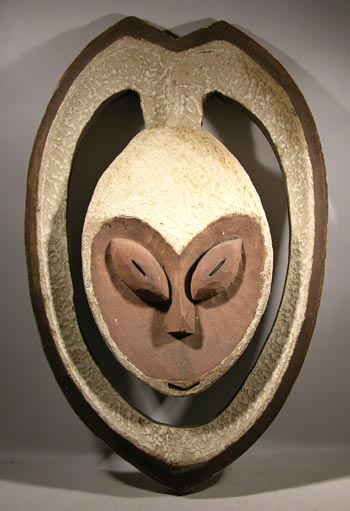
Kwele Mask — Gabon
Mid-20th Century
A fine older Kwele mask from Gabon of western coastal Africa. Lovely form and well carved example with large areas covered with
white textured kaolin paint. The white coloring on the mask represents the spirit world - peace and tranquility. This example has pierced eye slots although eyeholes are not always cut through.
Kwele mask are not worn on the face during ceremonies and instead are hand-held and shown to the spectators and onlookers. Kwele masks are carved and controlled by the Bwete association, which maintains social order within the tribe.
The masks represent the spirits of the forest and are used during initiation ceremonies and or at the end of a mourning period to promote tranquility and well-being within the community.
Kwele masks act as intermediaries between the world of the bush and that of the village.
The masks are typically heart shaped and have both human-like and animal features with the mouth being very close to the chin.
The eyes are narrow with wide arched eyebrows and a small pointed triangular nose. Kwele masks are thought to be among the most beautiful of all African masks.
Condition is near excellent. Minor scrapes and dings along with some staining and cracking of the kaolin paint, consistent with age.
Approx. 18" tall
$375
|
 |
|
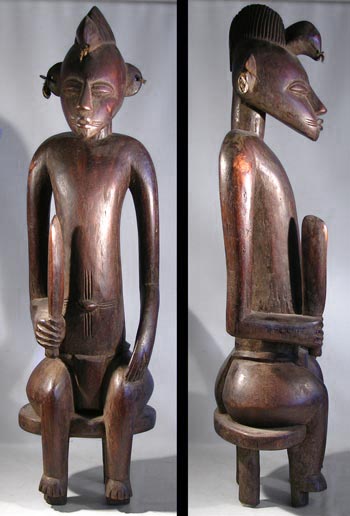
Senufo Seated Figure — Ivory Coast
Mid-20th Century
Large Senufo seated figure carved from dense (very heavy) hardwood. Nicely carved and of exceptional quality. The male figure is seated on a stool and holding a ceremonial blade.
It depicts a person of high status; likely a tribal ruler. He wears a loin cloth and has facial and body scarification. The ears and headdress are pierced for ornamentation.
One shell ornament remains intact. The other two holes have only remnants of the original thread. Overall condition is near excellent. A few surface scrapes, but generally choice. A fine
example that display dramatically.
Just under 25" tall
$1500
|
 |
|
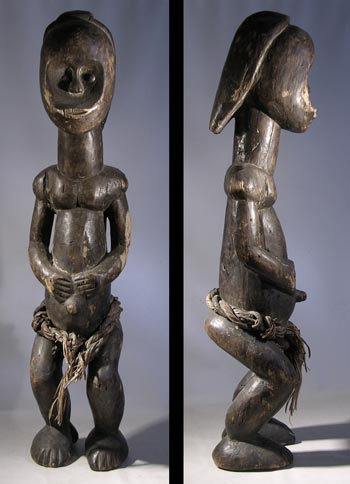
Fang Figure — Gabon
Mid-20th Century
A nice Fang figure from the Gabon area of Western Africa. He stands on large feet with hands held to the stomach. A woven fiber waist wrap is secured with iron nails.
Nails are also used for the eyes. Condition is good. Both legs have been reattached. Minor insect damage, surface scrapes and erosion consistent with age and exposure to the elements.
These types of "Bieri" figures are among the most desirable of all African sculptures. A fine example showing signs of tribal use and aged patina.
Approx. 23" tall
$850
|
 |
|
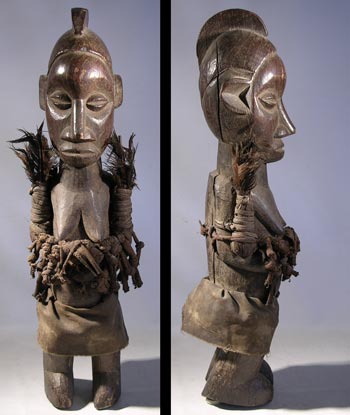
Yaka - Lula Figure — Congo
Mid-20th Century
A fine Yaka - Lula fetish bundle from the Democratic Republic of Congo. The standing female wears a skirt and waist wrap of knotted fabric. At her sides are
bundles of feathers wrapped with cloth and rattan fiber cords. This type of fetish was used by tribal healers (seers) during shamanic rituals.
In near excellent condition. A few vertical age cracks and minor insect damage, else choice. A well carved and exceptional example with obvious signs of tribal use.
Approx. 18" tall
$1250
|
 |
|
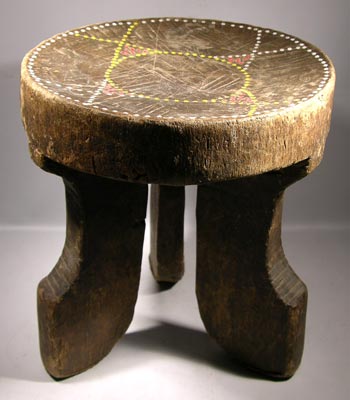
Kamba Beaded Stool — Kenya
Mid-20th Century
A fine Kamba stool from Kenya. Most likely dating to the 1960s. Well carved from a single piece of wood with inlaid glass beads recessed into the seat.
Stools of this type were reserved for male elders and were a prestigious display of wealth and respect. Condition is excellent. All of the beads are intact. Signs of wear from tribal use as
would be expected and desired. Very minor insect damage. Overall a great, older example.
Approx. 9" tall x 8" across
$375
|
 |
|
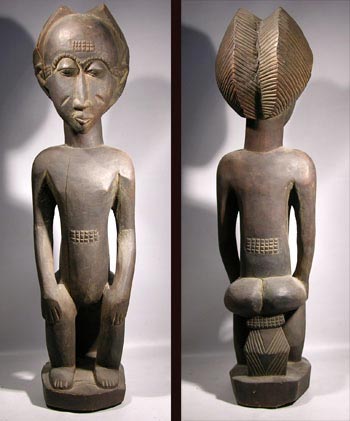
Baule Seated Figure — Cote d'Ivoire - Ivory Coast
20th Century
Nicely carved Baule figure from the Ivory Coast. Seated on a stool with hands resting on the knees. Beautifully detailed face and hair with body and facial scarification.
In fine condition with a few age cracks along the head and body, but overall near choice. An attractive example that displays well.
Approx. 17.5" tall x 4.5" across
$475
|
 |
|
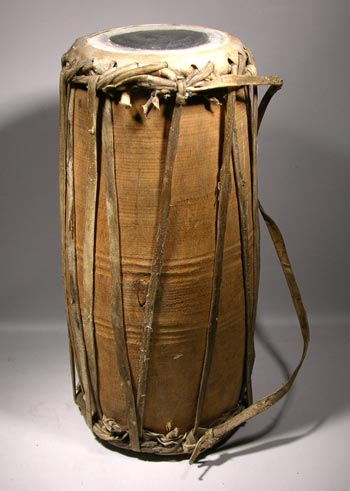
Chamba Drum — Nigeria
20th Century
Small two-headed drum from the Chamba tribe of Northern Nigeria. Gently tapered wooden body with animal hide drum-heads on both ends, lashed firmly together with strips of tanned hide.
An additional strip of hide serves as a handle. Overall condition is near excellent. Both heads on this drum are intact, tight, strong and playable. The drum-heads are rather small and would
have likely been played with the fingers or via sticks.
The Chamba people are a small group today living south of the Benue River in Northern Nigeria. This is an area of mixed art and influences.
Drums are among the most important art forms in Africa, used both as a musical instrument and as a work of sculpture significant in many ceremonial functions including dance, rituals, story-telling and communication of messages.
Approx. 10" tall x 4.5" across
$225
|
 |
|
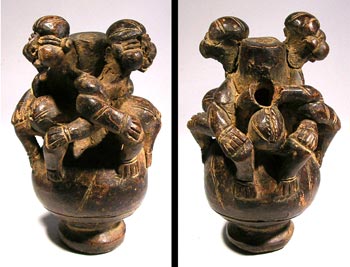
Tikar Oil Lamp — Cameroon
20th Century
Tikar pottery oil lamp from Cameroon. Footed base topped by a globular vessel. Around the upper portion are three seated figures, their arms locked together.
They sit surrounding the neck of the vessel; at the top is a small hole to hold the wick. The oil lamp would have been filled through a larger hole on the side.
Overall in good condition. Two of the heads have been reattached. The third head, which would have served as the stopper for the fill hole, is missing.
A nice example of the type.
Approx. 6.5" tall x 4" across
$85
|
 |
|
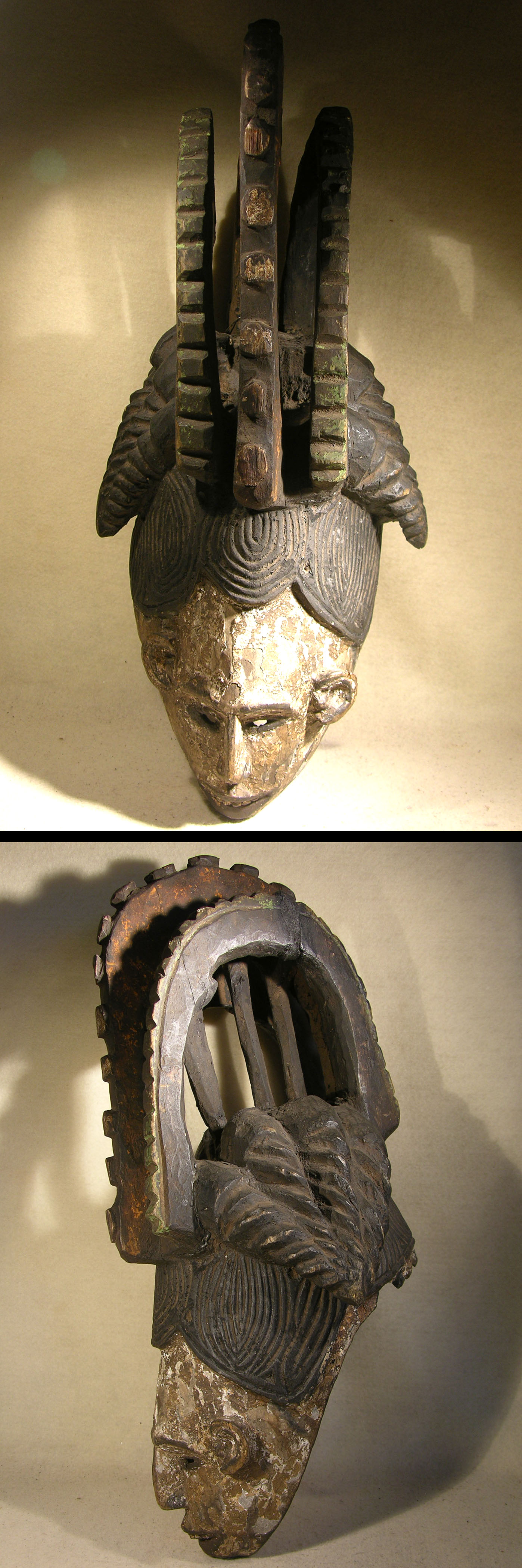
Igbo "Mmwo" Maiden-Spirit Mask — Nigeria, Africa
Early 20th Century, possibly late 19th Century
Exceptional example of an Igbo "Mmwo" mask. With a classic style face and soaring tripartite headdress, this large three-quarter type helmet mask shows superior craftsmanship as
well as obvious signs of age and tribal use. Finely carved with exquisite detail, the face shows a serene expression. The elaborate hairdo is realistically executed, topped
by a soaring superstructure of three large arches. The face is covered in the white pigment "kaolin". Other traces of green and orange pigment remains on the headdress.
Generally in excellent condition for its age. A few very minor losses and a single old indigenous (resin type) repair on the left arch of the headdress. Overall among the best example of
its type you'll ever see. Truly a museum quality item the likes of which are seldom seen in today's market.
The Igbo are a diverse culture, and their art reflect this. The early masks follow general stylistic guidelines, but later masks are found in a variety of sizes, colors, and uses.
This particular mask is however a classic example of Igbo artistry. The mask is called "Agbogho Mmwo," or the "beautiful maiden." Topped by elaborate coiffures, these masks are said
to represent the beauty and purity of deceased maidens. They were danced at yearly festivals called "Ude Agbogho," the festival of maidens, to honor past, prominent members of the village.
The purpose of this annual masquerade, which is performed by males, is to portray the physical and moral attributes of the ideal female.
Although the variety of specific details conveyed in Mmwo masks is virtually endless, the general form and artistic style displayed in this mask is faithful to early Igbo tradition.
Provenance: Ex. Hal Roach collection. Roach was a well known Hollywood producer and collector of fine, early African artifacts. Remembered for his vast contributions to early film and television
production, such as the "Laurel and Hardy" movies and the "Our Gang, Little Rascals" shorts, Roach also worked closely with Walt Disney for many years. Hal Roach died in Nov. 1992.
This mask and other pieces from his African art collection were recently sold off by his granddaughter, Mary Ellen.
Approx. 21" tall x 9" across
$2500
|
 |
|
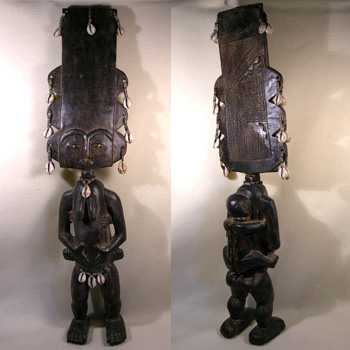
Fante Figure — Ghana
20th Century
Carved wood Fante (Fanti) female figure. With typical elongated square head, she stands with hands held to stomach and carries a child on her back.
Nicely carved in fine detail with intricate patterns on the back of the head. Heavily adorned with strands of beads and cowry shells.
An unusually large and beautifully executed example. In excellent condition showing no chips, cracks or breaks. Rare & choice.
Approx. 25" tall x 6" across
$850
|
 |
|
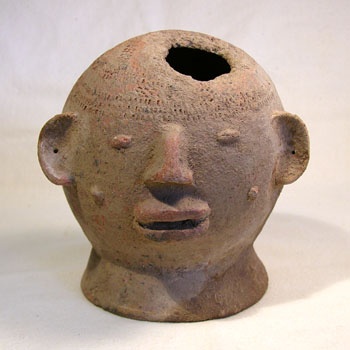
Bura Head Pot — Mali, West Africa
14th Century
Rare orange terracotta funerary vessel in the form of a human head. Raised eyes, lips and nose with curved ears.
Hair is indicated by a stippled design. Hole in the top of the head as is common. Fine condition with only minor chips missing around base.
Approx. 5" x 5"
$650
|
 |
|
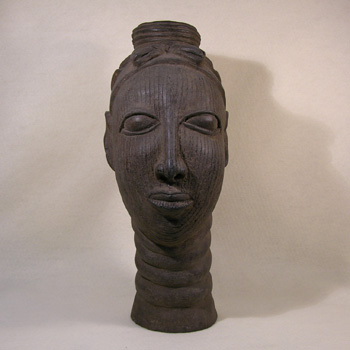
Ife Bust — Nigeria
Late 20th Century
Large gray terracotta female bust. Obviously a modern reproduction modeled after originals found at the great Yoruba center at Ife dating to 1100-1450 A.D.
This clay head is of an Oni, the ruler at Ife, who still holds power over the Yoruba people at Ife today.
A nice decorative piece in excellent condition.
Just over 16" tall
$225
|
 |
|
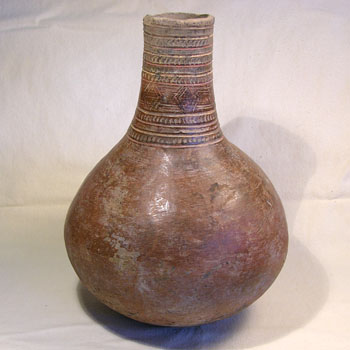
Large Terracotta Vessel — Mali
20th Century, possibly earlier
Fine reddish clay bottle with bands of decoration around the neck. Nice example, showing signs of tribal usage. Minor chips missing, otherwise choice.
Approx. 10" tall x 6"
$200
|
home | galleries > pre-columbian > colonial > shipibo > african > asian > classical > pacific rim | restoration services | display stands | about | contact
© 2024 Ancient Artifax LLC. All Rights Reserved. joey@ancientartifax.com
|
